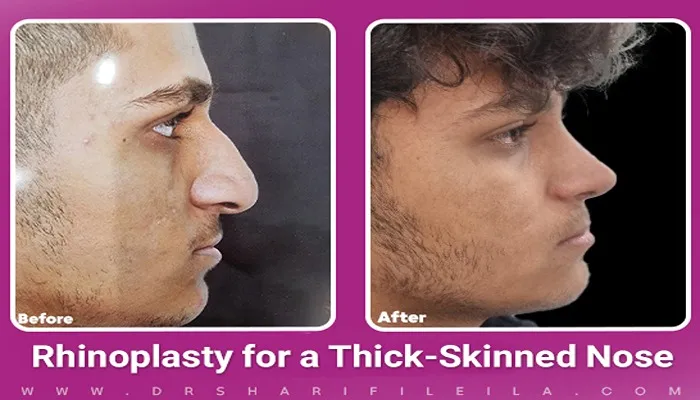
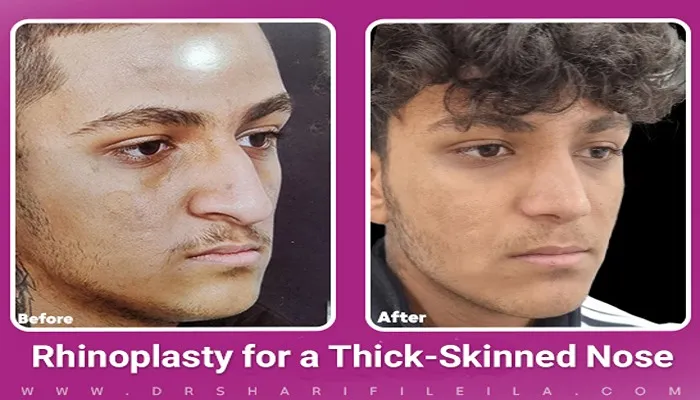
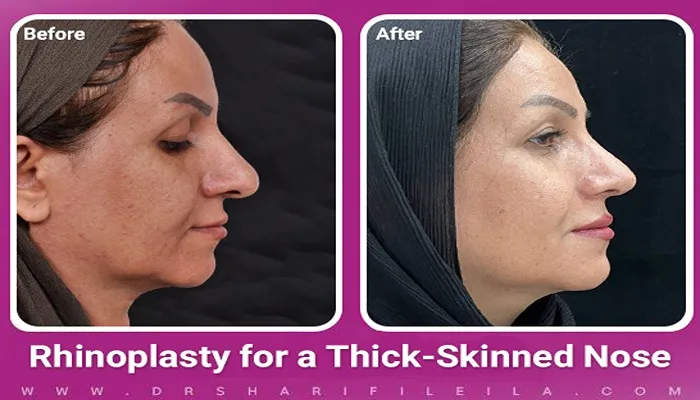
Why Does the Tip of a Fleshy Nose Appear Wide?
Because of the weakness of the nasal tip cartilages, when viewed from below, this type of nose may appear:
- Wider and larger
- Sometimes trapezoidal in shape
- Droopy, with limited definition of the nasal tip
This appearance is not caused by an excess amount of “flesh.” Rather, it is directly related to the underlying cartilaginous structure and its lack of adequate support.
Limitations of Traditional Techniques for Fleshy Noses
In the past, surgical approaches to fleshy noses were mainly based on:
- Removing supposedly excess tissue
- Attempting to thin the skin
- Excessive reduction of the nasal tip
These approaches not only often produced less predictable or less durable results, but in some cases could also lead to progressive nasal deformities over time.
The Modern Approach to ThickSkinned Rhinoplasty
With advances in rhinoplasty techniques, supported by extensive clinical experience and scientific research, it has become increasingly recognized that:
The fundamental principle of thick-skinned rhinoplasty is strengthening the internal nasal framework rather than excessive tissue removal.
Cartilage Strengthening: The Key to Successful Fleshy Nose Rhinoplasty
In modern rhinoplasty for thick-skinned noses, the primary focus is on:
- Increasing the structural strength of the nasal tip cartilages
- Reconstructing and reinforcing weakened nasal structures
- Creating a firm, stable, and well-defined nasal tip
By strengthening the underlying cartilage framework, the nasal tip can gradually develop better definition and proportion as healing progresses.
What Is Augmentation?
One of the important techniques used in this type of rhinoplasty is augmentation, which involves adding structural cartilage grafts to the nose.
Applications of Cartilage Grafting in Fleshy Noses
Cartilage grafts may be used to:
- Increase nasal tip projection
- Strengthen weak tip cartilages
- Reduce the risk of postoperative tip drooping over time
- Create a stronger, better-defined, and more aesthetically balanced nasal tip
Where Is the Graft Cartilage Obtained From?
Cartilage used in rhinoplasty is generally obtained from one of the following sources:
Nasal septal cartilage: Usually the first and preferred source when sufficient cartilage is available
Ear cartilage: May be used when the septum does not provide an adequate amount of cartilage
Rib cartilage: May be considered in patients with very thick skin and significant structural weakness or when a larger amount of strong cartilage is required
An important consideration is that the graft material must provide adequate structural strength for its intended purpose.
How Is the Available Cartilage Assessed Before Surgery?
To determine the most appropriate source of cartilage:
- A preoperative CT scan may be performed when clinically indicated.
- The available cartilage and relevant nasal anatomy are assessed.
- The surgical technique and the most appropriate graft source are selected according to the individual patient’s anatomy and needs.
Realistic Expectations from Fleshy Nose Rhinoplasty
In patients with thick-skinned noses:
Patience plays an important role in the recovery process.
Nasal swelling and definition improve gradually.
The final result may take considerable time to become fully apparent.
The degree of achievable change depends on several factors, including:
- Skin thickness
- Strength and quality of the nasal cartilage
- The amount and quality of cartilage available for structural grafting
The Extent of Change in Fleshy Nose Rhinoplasty
With modern, structurally based techniques, it is possible to achieve significant and lasting improvements in nasal shape and definition.
The achievable degree of change varies considerably from patient to patient and depends on individual anatomy, skin characteristics, cartilage strength, and the surgical technique used. The goal is to create a stronger, more defined, and proportionate nasal tip while maintaining a natural appearance and minimizing the risk of recurrent drooping.
Final Thoughts on Fleshy Nose Rhinoplasty
Noses commonly referred to as “fleshy” are, in many cases, noses characterized by thick skin and relatively weak or under-supported cartilage. Successful rhinoplasty for this type of nose relies less on aggressive reduction and more on strengthening the internal nasal framework and using cartilage grafts appropriately when indicated.
By choosing a surgeon who is experienced in modern structural rhinoplasty techniques, undergoing a thorough preoperative evaluation, and maintaining realistic expectations and patience throughout the healing process, patients can achieve a more natural-looking, stable, and satisfying result.